December 2024
Engaged Scholars is a series highlighting Ohio State faculty who have made an impact in our communities through their community-engaged research and teaching.
Paula Meijerink
Associate Professor in Landscape Architecture
Knowlton School, College of Engineering
My research lies at the intersection of material ecologies and equity; it focuses on strategies to improve dehumanized and denatured urban conditions, often related to impervious surfaces and urban tree canopy cover. I advance knowledge in collaborative practices, especially in and with underserved communities. My creative practice is geared toward processes that improve socioenvironmental inequities in which cultural competency is integrated in teaching, research and service, often intertwined.
My research on the materiality of landscape includes the introduction of organic life into hostile, human-altered environments within the context of human experience. Scientific research shows consistent city-scale patterns of elevated land surface temperatures in formerly redlined neighborhoods in the United States, which indelibly links urban temperatures, tree canopy cover, and impervious surfaces; all affecting the quality of life for people. Therefore, my research is focused on design solutions that mitigate urban social-environmental disparities. Much of my work relates to the transformation of impervious surfaces such as asphalt, and I investigate urban forests as the discipline's most effective means to address climate change while improving the health and wellness of people.
Why is it important to engage the community in your research and teaching?
In landscape architecture, we continuously engage with communities, often synthesizing solutions for complex problems. As an academic, I cultivate a porosity and interaction between academic research and teaching, and the community, because knowledge is immediately processed and disseminated; this works in several ways. This interaction is an opportunity to provide a larger sociopolitical context and environmental goals to the community, and to share solutions provided by other communities. It allows me to reflect on and interact with first-hand concerns, therefore adjusting or finetuning my research goals and methods. By integrating community engagement within the learning process, students get a first-hand knowledge of communities, their aspirations and concerns. I am currently collaborating with faith-based community partners on fieldwork initiatives, as these communities already have a social agenda and increasingly so an environmental agenda as well. High school students are especially eager to work on community engagement.
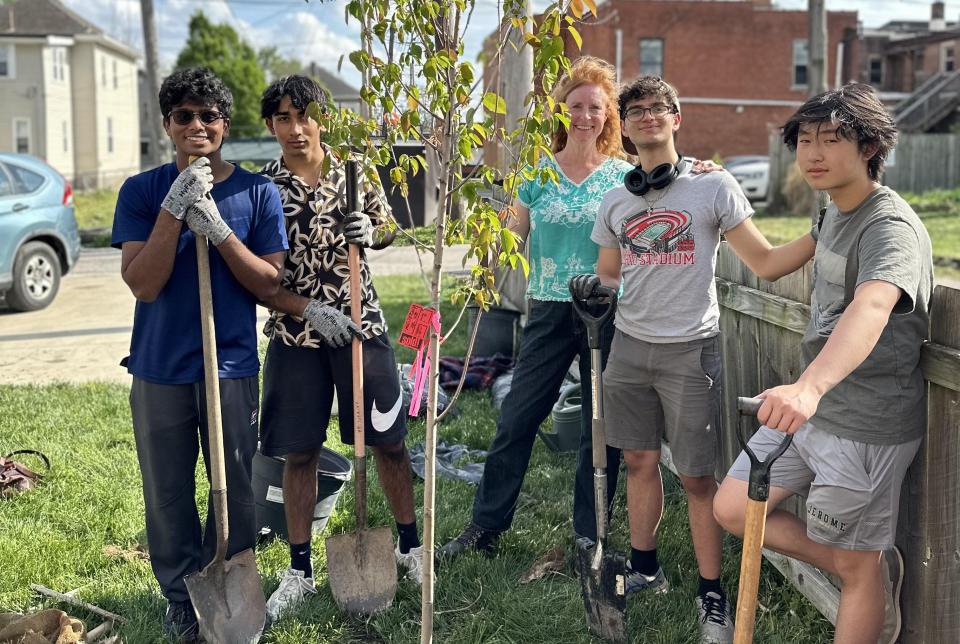
In 2021, with Senior Instructor Ethan McGory, we developed the Trees for All People program that is focused on socioenvironmental equity and community resilience. We engage with the Columbus Southside community in developing green infrastructure initiatives that seek greater urban resilience, greater well-being for residents, increased biodiversity, stormwater retention and spatial quality.
What led you to the path of engaged scholarship? How did you get started?
As a landscape architect, community engagement is a fundamental and normalized component of professional practice. It was only natural that this professional engagement continued in my academic career where I seek an active and generative interaction between the external world and academia. I understand engaged scholarship as generating knowledge through interacting with people around a common agenda. This can take the form of seeking solutions to social environmental dilemmas, material experimentation or generating interesting spatial solutions.
Covid and the death of George Floyd was an important moment in my academic trajectory. For me, it foregrounded the blatant inequities in the urban lived environment across the United States and clarified that my work as an academic and landscape architect could influence that. While I always interacted with people and communities, since 2020, my work has a greater emphasis on underprivileged communities.
How has your scholarship benefited from engaging with community partners?
As these are intertwined, my scholarship cannot be seen independently of teaching and service. As my research focuses on strategies that improve dehumanized and denatured conditions, community engagement is fundamental in understanding the social dimensions of making changes. Here the development and nourishment of collaborative practices are underpinning productive actions.
In the design of the urban environment, conventional terminology separates the built environment from the natural environment; however, the term lived environment is much more appropriate as it is inclusive; unlike the previous terminology, it includes people and can include nature. In my work, design strategies include the well-being of people, community engagement, and spatial and ecological improvement of the lived environment, often with disadvantaged communities. I disseminate my research in local and academic communities through talks, lectures, workshops and conferences. Community engagement is integrated in my courses.
What has been a highlight of your community engagement experience?
In my work with the Southside community on Trees for All People, a resident more than 90-years-old, living alone, had signed up for a tree through the church. This woman is not on social media, does not communicate through email and does not always pick up the phone, so we could not confirm and organize the details of tree planting with her. Despite this lack of communication, we had OUPS mark the underground utilities in her yard and had purchased a tree for her. So, at the end of the day when we were distributing and planting trees in the neighborhood, we tried one more time to contact her and rang the doorbell. We waited a while, to no affect, and as a last effort, I called her again. She unexpectedly picked up the phone; she had been in the basement, so she had not heard the doorbell. Yes, she did want a tree; she mentioned that no one had ever planted a tree in her yard before, so she was excited about this. And would she be interested in a second, flowering tree (we had an extra tree)? Yes, she was. So, with students, we planted these trees for her. This interaction underscored the effectiveness of the work that we were doing in the neighborhood.
What advice would you give to faculty and students who are interested in engaging the community in their scholarship?
Working with communities and community partners is not a linear process; rather, it is circuitous and sometimes convoluted, affected by financial constraints, process barriers, conflicting goals and availabilities and it is time consuming. But with fostering and sustaining social connections, and with tenacity, improvements happen. Communicate, as often as possible, and with as many people as possible in many contexts.
Sample Engaged Scholarship
Academic consultant to the Hudson community in Quebec, Canada, to present conservation strategies of a tract of beach front forested land, with streams, with 29 at risk species, subject to development of 200+ town houses. 2024
Trees for All People was awarded Program of Excellence in Engaged Scholarship from the Ohio State University's Office of Outreach and Engagement (Paula Meijerink and Ethan McGory), 2024
Meijerink, Paula. Lecture at University of California, Berkely, College of Environmental Design. "Dense Matter: Hard, Tough, and Ferocious. Toward a humanized Environment," 2024
I collaborated with artist Rand Abdul Jabbar (Abu Dhabi, UAE), to construct a rammed earth artwork at the Contemporary Arts Center (Cincinnati, Ohio) titled Tektn (after Zaha, after Malevich). Group exhibition titled A Permanent Nostalgia for Departure by curator Maite Borjabad (Bilbao, Spain) and this artwork was developed with students in landscape architecture from Knowlton, design students from the University of Cincinnati College of Design, Architecture, Art, and Planning, and the construction team at the Contemporary Arts Center. The complex organization included collaboration across five time zones. 2023-2024
Keynote speaker at the Ohio Urban Forestry Conference, "Urban Reclamation with Trees as Climate Positive Design," 2022
Selected speaker at the International Symposium Urban Forests, Forest Urbanisms & Global Warming (Katholieke Universiteit Leuven, Belgium). Meijerink, Paula. "Trees for All People: Forest pilot projects with the Columbus Southside as process models for underserved communities," 2022
Trees for All People was selected at the Green New Deal Superstudio and aired nationally; it was exhibited at the National Building Museum in Washington DC, 2021, 2022
Courses: LARCH 3950 Trees For All People, SP 2022, SP 2023; LARCH 5194 Trees For All People, SP 2021